One Garage — speed you expect, quality you trust.
Speed you count on. Quality you trust.
Audi e-tron / Q8 e-tronFront and rear drive unitHybrid ceramic bearings

Why Ceramic Bearings Are Used in Audi e-tron Electric Motors

For Audi e-tron, bearing choice is not just about part price. High rotational speed, thermal load, parasitic currents, seals, mechanical seal condition and shaft grounding all matter.

Below is an engineering comparison of standard and hybrid ceramic bearings, an explanation of electrical erosion mechanisms and a practical conclusion on when ceramic bearings in Audi e-tron truly make sense and when a standard solution may still be acceptable.

Audi e-tron front electric motor bearings

This page uses real Audi e-tron part photos and generalized engineering data on hybrid bearings based on SKF, NSK, Schaeffler and ABB materials.

Page contents

Why compare two bearing types in an EV at all

In a traction electric motor, bearing type affects far more than mechanical noise. It influences resistance to electrical erosion, grease temperature, allowable speed, preload stability and the risk of a repeat repair after the motor is opened.

A hybrid ceramic bearing is not an all-ceramic bearing. In most cases it combines steel rings with silicon nitride (Si3N4) balls. This provides electrical insulation through the rolling elements while preserving the standard bearing geometry and fits.

Operating conditions for a bearing in an Audi e-tron electric motor

01

High speed

An EV traction motor operates at high rotational speed for long periods. Rolling element inertia, friction and geometric stability under load are critical.

02

Higher temperature

Heat comes not only from the bearing itself, but also from the motor, inverter and overall drive unit thermal environment. This directly affects grease and service life.

03

Parasitic currents

In inverter-fed systems, bearing currents may appear. When the oil film breaks down, electrical discharges can cause pitting, fluting and accelerated raceway wear.

04

The whole assembly matters

In Audi e-tron, the bearing cannot be considered separately from seals, the mechanical seal, grounding ring, overall sealing integrity and traces of coolant inside the motor.

Main comparison table: standard vs hybrid ceramic bearing

ParameterStandard bearingHybrid ceramicPractical meaning
Ball materialSteelSilicon nitride (Si3N4)Lower mass, higher electrical resistance
Ball density7.9 g/cm³3.2 g/cm³Lower inertia and better high-speed behavior
Hardness HV10~700~1600Higher wear and contamination resistance
Thermal expansion12 ×10⁻⁶/K3 ×10⁻⁶/KMore stable preload at temperature
Electrical propertiesConductorInsulatorReduced risk of electrical erosion
Limiting speedBaselineUp to +20% in some applicationsUseful for high-speed EV traction motors
Grease lifeBaselineUp to 2× in some applicationsLower friction and temperature
PriceLowerHigherOften justified when repeat repair risk is expensive

The economic case for ceramic bearings in Audi e-tron

When repairing an Audi e-tron electric motor, you should consider not only the bearing price, but the full cost of repair: motor removal and teardown, risk of repeat noise, likelihood of electrical erosion and the actual service life of the rebuilt assembly.

The part price is not the main expense

A standard bearing is cheaper, but in Audi e-tron the major cost often comes from removing, disassembling and reassembling the electric motor.

Repeat repair costs more

If noise, EDM damage or raceway defects return after installing a standard bearing, the owner pays for the same labor-intensive work again.

Ceramic reduces financial risk

Hybrid bearings with Si3N4 balls reduce EDM risk, lower friction and cut thermal load, helping reduce the chance of another teardown later.

With Audi e-tron, the owner does not just pay for the bearing — they pay for access to it. That is why ceramic bearings often turn out to be not only the better technical option, but the more rational economic one as well.

When a standard bearing still makes sense

  • the repair is early and damage is limited;
  • there are no signs of EDM or repeat noise;
  • the budget is strictly limited.

When ceramic is economically stronger

  • the motor has already been opened before;
  • there is noise after load or at high speed;
  • electrical erosion marks are visible;
  • reducing the risk of a second repair matters more than saving on one part.

What is replaced together: real motor-unit solutions

In Audi e-tron, the issue is rarely limited to a single bearing. In practice you often have to look at the entire chain: sealing → leak → contamination/moisture → bearing wear → noise → risk of a much more expensive repair.

If you need the service page, see Audi e-tron bearing replacement. If the damage may be deeper than the bearing itself, go to Audi e-tron motor repair and replacement. If there are signs of coolant loss, also review Audi e-tron coolant leak.

Audi e-tron front motor repair kit with ceramic bearings
SKU: ETRONF-REPAIR-KIT-CER

Front motor Audi e-tron / Q8 e-tron — ceramic repair kit

A complete front drive unit repair set with hybrid ceramic bearings, seals and related sealing components.

Pricefrom 799 €
  • Fits APA250 / APA320
  • Rational choice for noise, electrical erosion and repeat repair cases
  • Available as parts only or with installation at the workshop
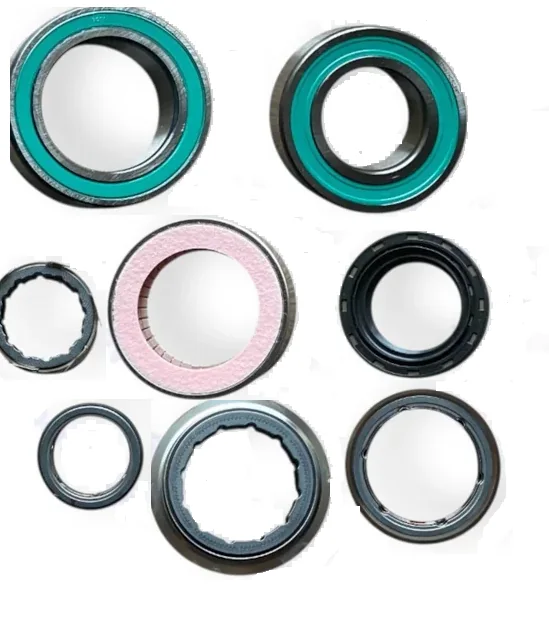
Audi e-tron rear motor repair kit
SKU: ETRONR-REPAIR-KIT-CER

Rear motor Audi e-tron / Q8 e-tron — ceramic repair kit

A rear drive unit kit focused on durability, protection against current damage and high-speed stability.

Price1468 €
  • Fits AKA320
  • Relevant for noise, vibration and long-term use
  • You can send a VIN for accurate kit matching

FAQ

Does a hybrid ceramic bearing make the motor “lifetime-proof”?

No. It solves only part of the problem — mainly electrical erosion, high-speed behavior and thermal stability. If a bad seal, coolant contamination or a worn shaft remains, one bearing alone will not fix the system.

Are ceramic bearings worth the extra cost in Audi e-tron?

If the goal is the lowest repair cost right now, a standard bearing may still be acceptable. But if there is a risk of repeat noise, electrical erosion or another motor teardown, a hybrid ceramic bearing is often cheaper in total repair cost.

Why can a more expensive bearing be economically better?

Because in Audi e-tron the main cost is often not the part itself, but removing, disassembling and reassembling the electric motor. If a more expensive bearing reduces the risk of a second repair, it lowers the owner’s total spend.

International sources and technical basis

  1. SKF — Hybrid bearings, motor applications, material properties of bearing steel vs silicon nitride.
  2. SKF — Rolling bearings and seals in electric motors and generators.
  3. NSK — Hybrid Bearings with Ceramic Balls.
  4. Schaeffler — Hybrid Bearings for Maximum Performance and Reliable Protection.
  5. ABB — Bearing currents and how to beat them / insulation strategies for inverter-fed motors.
  6. Scientific reviews on bearing currents and electrical erosion in electric machines.
CallRoute